


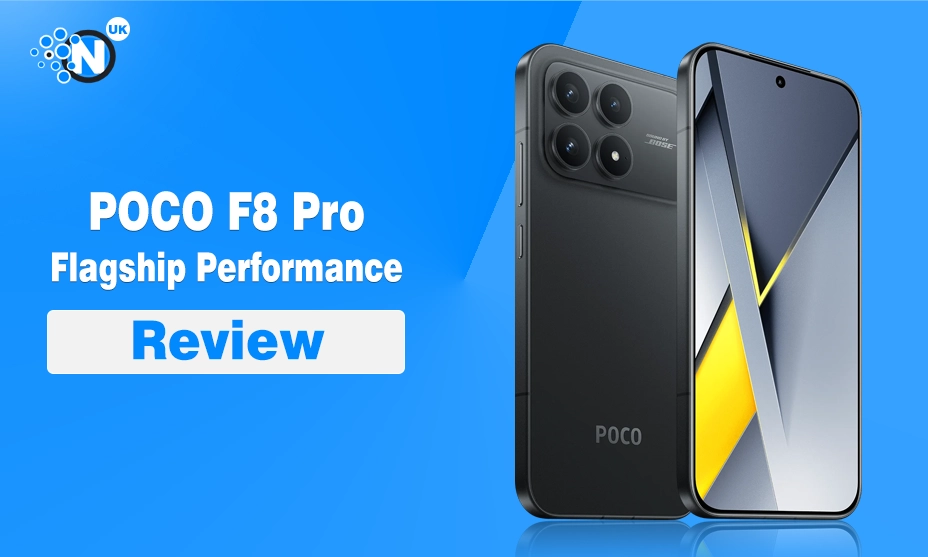
The POCO F8 Pro is one of the strongest Android phones to consider if you want flagship-level performance without paying flagship prices. It combines Qualcomm’s Snapdragon 8 Elite processor with 12GB of RAM, a 120Hz AMOLED display, a huge 6,210mAh battery and 100W wired charging.
Its appeal is straightforward: POCO has concentrated the budget on the parts that affect speed, gaming, battery life and everyday responsiveness. The compromises appear elsewhere. Its cameras are capable rather than class-leading, there is no wireless charging, and Xiaomi’s HyperOS 3 is not as clean or refined as the software experience offered by Google or Samsung.
The POCO F8 Pro originally carried a UK price of £549 for 12GB/256GB and £599 for 12GB/512GB, although Xiaomi promotions and wider retail discounts have repeatedly brought the 256GB model down to around £449 and the 512GB version to around £499. At those discounted prices, the value proposition becomes considerably stronger.
So, should you buy it? Yes, if performance, battery life and fast charging are higher priorities than photography, wireless charging or having the cleanest Android interface.
POCO F8 Pro Key Specifications
| Specification | POCO F8 Pro |
| Display | 6.59-inch AMOLED |
| Resolution | 2510 × 1156 |
| Refresh rate | Up to 120Hz |
| Processor | Snapdragon 8 Elite |
| RAM | 12GB LPDDR5X |
| Storage | 256GB / 512GB UFS 4.1 |
| Main camera | 50MP with OIS |
| Telephoto camera | 50MP, 60mm / 2.5x |
| Ultra-wide camera | 8MP |
| Front camera | 20MP |
| Battery | 6,210mAh |
| Wired charging | 100W HyperCharge |
| Wireless charging | No |
| Reverse charging | Up to 22.5W wired |
| Connectivity | 5G, Wi-Fi 7 support |
| Water resistance | IP68 |
| Software | HyperOS 3 based on Android 16 |
| Weight | 199g |
| UK RRP | From £549 |
| Typical discounted price | Around £449 for 256GB |
Design and Build Quality
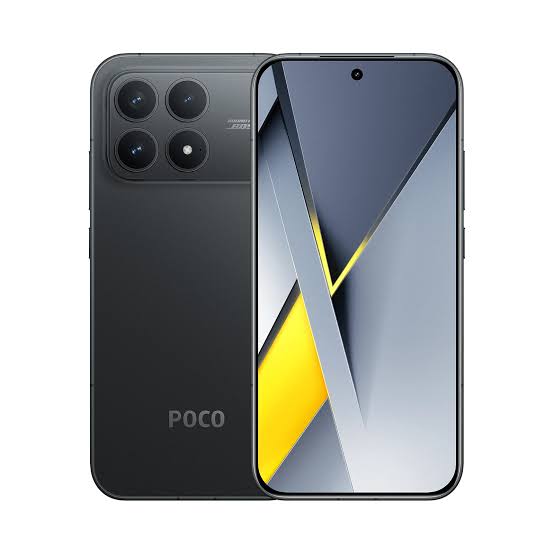
The POCO F8 Pro feels more mature than the aggressively styled performance phones POCO was once associated with.
Its aluminium frame, flat sides and relatively restrained rear camera design give it a more premium appearance, while IP68 dust and water resistance provides a level of protection expected from considerably more expensive phones. An ultrasonic in-display fingerprint sensor is another welcome flagship-style addition.
At around 157.5mm tall, 75.25mm wide, 8mm thick and 199g, it is not a small phone, but it is more manageable than many oversized gaming and flagship devices.
That matters because the F8 Pro does not really look like a dedicated gaming handset. You can get serious mobile gaming performance without carrying a phone covered in RGB lighting, dramatic vents or an obviously gamer-focused design.
The main practical limitation is connectivity through the USB-C port. The phone does not provide the faster USB data transfer speeds available on some more expensive flagships. There is also no wireless charging.
Display Quality
The 6.59-inch AMOLED display is one of the POCO F8 Pro’s strongest features.
Its 2510 × 1156 resolution provides a sharp image, while the refresh rate can increase to 120Hz in supported applications. That makes scrolling, animations and high-frame-rate games feel noticeably smoother than they do on basic 60Hz displays.
POCO claims a peak brightness of up to 3,500 nits across part of the screen, with 2,000-nit high-brightness mode and 600-nit typical brightness. It also supports HDR10+ and Dolby Vision.
Independent display measurements have also found strong colour accuracy, making this more than a specifications-first panel. It is well suited to Netflix, YouTube, games, social media and everyday browsing.
For a phone regularly selling around the £449–£499 range, the display is difficult to criticise.
Performance
Performance is the main reason to buy the POCO F8 Pro.
Instead of using a typical mid-range Snapdragon processor, POCO has equipped the phone with the Snapdragon 8 Elite, Qualcomm’s former flagship 3nm mobile platform. It is accompanied by 12GB of LPDDR5X RAM and either 256GB or 512GB of UFS 4.1 storage.
That combination gives the phone substantially more processing power than the chips normally fitted to mid-range Android devices.
Day-to-day tasks such as browsing, social media, photography, multitasking and switching between demanding applications should therefore present little difficulty. More importantly, the additional GPU performance makes the F8 Pro particularly attractive if you intend to keep the device for several years or regularly use demanding applications.
Independent benchmark testing has positioned it closer to genuine flagship phones than conventional mid-range handsets. TechRadar concluded that its processor is exceptionally strong at this price, while Expert Reviews also found performance worthy of being described as flagship-class.
Raw benchmark numbers are not everything, however. Processor efficiency, sustained performance and thermal management also determine how fast a phone feels during long sessions. This is the ideal natural anchor for the relevant LogicTech.uk article.
Under sustained high-intensity gaming, the F8 Pro can become warm, so the Snapdragon 8 Elite does not remove the normal thermal limitations of powerful mobile hardware.
For ordinary users, there is significantly more performance here than most everyday applications require.
Gaming Performance
The POCO F8 Pro is especially easy to recommend to mobile gamers.
The combination of the Snapdragon 8 Elite, Adreno graphics, 120Hz AMOLED display, large battery and fast storage creates the hardware foundation needed for demanding Android games.
POCO also includes Game Turbo, and Xiaomi says supported titles can reach high-frame-rate modes of up to 120fps in games such as PUBG Mobile, Call of Duty Mobile and Mobile Legends, although actual frame rates still depend on the game, settings and software support.
Players looking for games that do not require a permanent connection can also explore our selection of offline Android games.
Compared with an inexpensive tablet such as the Samsung Galaxy Tab A9, which uses the much less powerful MediaTek Helio G99, the F8 Pro sits in a completely different performance category.
There are faster specialist gaming phones, particularly models built around newer flagship processors and dedicated cooling hardware. But those devices often sacrifice design, camera practicality or mainstream usability to achieve maximum gaming performance.
The F8 Pro is more balanced. It behaves like a normal premium Android phone while still delivering enough power for serious gaming.
Camera Performance
Cameras are where POCO’s priorities become more obvious.
The rear system consists of a 50MP main camera with optical image stabilisation, a 50MP 60mm telephoto camera and an 8MP ultra-wide camera. There is also a 20MP front camera.
The main camera is the best of the three. In good light it can produce sharp, attractive photographs with pleasing colour and useful dynamic range.
The 50MP telephoto is also a meaningful addition because it provides roughly 2.5x optical zoom, giving users more framing flexibility than many mid-range phones. However, the telephoto camera lacks optical image stabilisation, so it is more susceptible to blur when the phone is not held steadily.
The 8MP ultra-wide is considerably less impressive and is one of the obvious areas where POCO has controlled costs.
Video from the main rear camera can reach 4K at 60fps or 8K at 30fps, although buyers who care heavily about video quality may still prefer an iPhone, Pixel or premium Galaxy device. The front camera is limited to 1080p video.
The overall verdict is therefore simple: the cameras are perfectly usable for everyday photography, but they are not the reason to buy the POCO F8 Pro.
Battery Life
The 6,210mAh battery is arguably as important as the Snapdragon processor.
That capacity is considerably larger than what many mainstream phones offer, and the use of silicon-carbon battery technology helps POCO fit more capacity into a relatively conventional 8mm-thick handset.
Independent testing has been particularly positive. Expert Reviews recorded more than 32 hours in its looping video test, while TechRadar reported roughly seven to nine hours of screen time across as much as two days depending on usage and settings.
Those figures will vary considerably in real life. Gaming, 5G usage, maximum brightness, navigation and prolonged camera use can drain the battery much more quickly.
Even so, battery endurance is clearly one of the F8 Pro’s biggest strengths.
100W Fast Charging
When the battery does eventually run low, the F8 Pro supports 100W HyperCharge.
Independent testing has shown a full charge taking roughly 40–42 minutes with compatible hardware.
There is an important catch for UK buyers: Xiaomi does not include the 100W power adaptor in the box. Xiaomi recommends using a compatible charger, including its 120W adaptor, to access the phone’s fastest charging capability.
The F8 Pro also supports up to 22.5W wired reverse charging, meaning it can provide power to another compatible device through a cable.
Wireless charging, however, is absent.
That omission is easier to accept when the phone is heavily discounted, but buyers already using wireless charging pads throughout their home or car should keep it in mind.
HyperOS 3 Software
The POCO F8 Pro launched with Xiaomi HyperOS 3 based on Android 16.
HyperOS offers extensive customisation, multitasking features, Xiaomi ecosystem integration and useful gaming tools. Animations are smooth and the powerful processor helps the interface feel consistently responsive.
The issue is not speed. It is polish.
The software includes pre-installed applications and system-level recommendations or advertising in some Xiaomi apps. Many unwanted applications can be removed, but the initial experience is less clean than what Google provides on a Pixel.
Samsung’s One UI also feels more cohesive for users who already own Galaxy tablets, watches or earbuds.
HyperOS is therefore unlikely to ruin the F8 Pro for most buyers, but software-sensitive users should consider it one of the phone’s bigger compromises.
POCO F8 Pro vs Google Pixel 10a and Samsung Galaxy A57
The most interesting competitors are not necessarily gaming phones. They are mainstream devices such as the Google Pixel 10a and Samsung Galaxy A57, which target buyers in a broadly similar price range.
The Pixel 10a is more attractive if your priorities are Google’s Android experience, photography, AI integration and longer-term software confidence. Its raw processing hardware, charging and battery specifications are less aggressive than POCO’s.
Samsung’s Galaxy A57 takes a similar approach. It places greater emphasis on software support, Samsung ecosystem integration and mainstream availability rather than maximum processing performance.
The POCO F8 Pro takes the opposite route.
It gives buyers a flagship-class Snapdragon processor, faster charging and a much larger battery while accepting compromises in photography and software refinement.
Recent comparisons place the Pixel 10a at around £449 and the Galaxy A57 around the £450 mark, putting both directly into POCO territory when the F8 Pro is discounted.
For buyers seeking maximum performance per pound, POCO has the advantage.
Advantages of the POCO F8 Pro
The F8 Pro makes the most sense if you want:
- Flagship-class Snapdragon 8 Elite performance
- Excellent Android gaming capability
- A sharp 120Hz AMOLED display
- 12GB of fast LPDDR5X RAM
- 256GB or 512GB storage
- Excellent battery endurance
- 100W wired charging
- IP68 dust and water resistance
- A useful 2.5x telephoto camera
- Strong value when discounted to around £449
Reasons to Look Elsewhere
Another phone may suit you better if your priorities include:
- Class-leading camera quality
- The best ultra-wide camera
- Highly stabilised telephoto photography
- Wireless charging
- A clean, near-stock Android interface
- Minimal pre-installed software
- The strongest ecosystem integration
- Premium video recording
Final Verdict: Is the POCO F8 Pro Worth Buying?
Yes. The POCO F8 Pro is worth buying in the UK, particularly when the 256GB model is available around £449.
It does not try to beat an iPhone, Pixel or premium Samsung Galaxy in every category. Instead, POCO has concentrated on performance, display quality, gaming, battery capacity and charging speed.
That strategy works.
The Snapdragon 8 Elite remains extremely powerful, the 120Hz AMOLED display is excellent, and the 6,210mAh battery gives the phone endurance that many more expensive devices struggle to match. Add 100W charging, 12GB of RAM, fast UFS 4.1 storage and IP68 protection, and the hardware package becomes difficult to ignore.
The trade-offs are equally clear. HyperOS still needs refinement, the ultra-wide camera is ordinary, the telephoto camera lacks OIS, there is no wireless charging, and the fastest charger is not included in the UK box.
At the full £549 RRP, competition becomes considerably stronger. At around £449, however, those compromises are much easier to accept.
If performance, gaming and battery life matter more to you than camera perfection or software polish, the POCO F8 Pro is one of the strongest value-focused Android phones in its class.
Frequently Asked Questions
How much does the POCO F8 Pro cost in the UK?
The POCO F8 Pro has a UK RRP of £549 for the 12GB/256GB model and £599 for the 12GB/512GB version.
Is the POCO F8 Pro good for gaming?
Yes. The Snapdragon 8 Elite processor, 12GB LPDDR5X RAM and 120Hz AMOLED display make it particularly well suited to demanding Android games.
Is the POCO F8 Pro camera good?
The 50MP main camera is capable and the 50MP 2.5x telephoto adds useful versatility. However, the 8MP ultra-wide, unstabilised telephoto and limited front-camera video mean photography is not the F8 Pro’s strongest area.
How big is the POCO F8 Pro battery?
It has a 6,210mAh typical battery capacity, which is unusually large for a phone of its size.
Does the POCO F8 Pro support 100W fast charging?
Yes. The POCO F8 Pro supports 100W HyperCharge, although the required high-power adaptor is not included in the UK box.
Does the POCO F8 Pro support wireless charging?
No. The F8 Pro supports fast wired charging but does not offer wireless charging.
What Android version does the POCO F8 Pro use?
The phone launched with Xiaomi HyperOS 3 based on Android 16.
Is the POCO F8 Pro waterproof?
It carries an IP68 dust and water-resistance rating under specified laboratory conditions. Like other water-resistant phones, this should not be treated as permission for deliberate or prolonged underwater use.
Is the POCO F8 Pro worth buying in 2026?
Yes, especially at around £449. Buyers prioritising speed, gaming, display quality, battery life and charging receive unusually strong hardware for the money.
